Showing posts with label art. Show all posts

Saturday, September 21, 2013

Wooden work by Michael Cheshire


Today I received a wooden work by Michael Cheshire. It's one of his series of artworks with cats. Here, you can see a cat looking at huge moon. The scene is decorated by impossible frame.

Michael Cheshire creates his works from many kinds of wood. You can see more his works and by them at his web site http://www.woodenart.com.au/

Sunday, July 12, 2009

The Great Wave off Kanagawa

Some time ago, talking about fractal waves I referred to the artwork of XIX century The Great Wave off Kanagawa by japanese artist Hokusai. It was very interesting to see in old artwork selfsimilar shapes like in fractals. This artwork is of great importance to Japanese.

So, it was printed on postage stamps and became inspiration for many designer works. Even more it's motif was used in Nintendo game The Demon Blade. It's 2D adventure game with many traditional Japanese scenes. Two of them show the Great Wave in sunny day and in storm.


Another painting based on the famous artwork is The Great Monkey Wave. From afar it looks like an original image but nearby we see that the wave is filled with numerous monkeys.

Sunday, July 5, 2009

Calendar 2010

Today I would like to promote an outstanding issue, to which I attended. It's a bloc-calendar with illusions. Every page contains unique graphic work, photo or photomanipulation image with illusion or impossible figure. Arworks of such famous artists as M.C. Escher, Jos de Mey, Sandro del Prete, Istvan Orosz, Oscar Reutersvärd and many many others. Also, some my figures were printed in the calendar too.

The bloc-calendar was created in Paul Baars Design studio. Most of the Dutch museums will have it in their shops.


Friday, January 9, 2009

Escher-like mosaics

M.C. Escher is well known by his artistic regular plane divisions and artworks of impossible constructions. But he also created several artworks with irregular mosaics, which consist of shapes of various animals. Two of them you can see below. As you can see every animal in mosaics are fit all its neighbours without any gaps.
Today may artists follow the way of Escher in creating complex mosaics. Images of Bobby Bogl are worthy, which you can see below. Take a notice of how all parts of his images accurate match to each other.


Sunday, July 6, 2008

Tessellations of David Bailey

M.C. Escher was the first, who used figures of birds, fishes, lizards and other animals for artistic regular plane division. Many followers then created numerous tessellation images.

One of them is artist from England David Bailey. He creates his images in pen and watercolour.

The main motifs of his tessellations are birds.


The more complex constructions come in, when two distinct motifs are used in conjunction with each other.


Besides usual animals David Bailey uses imaginary creatures to create his wonderful artworks. Below you can see dinosaur-like creatures. The main distinguishing feature of this drawing is that only part of the image was used for animals, when other space shows only borders of elementary tiles. It helps to better understand, which kind of symmetry was used in every case.

Also he created several artworks, which reminds Escher's artworks with mutable tessellations like Metamorphoses. The image below shows the same process as in Escher's lithograph Development I. But David Bailey used birds as motif for his artwork instead of Escher's lizards.


The reverse process is shown in the image below.
More images by David Bailey you see at his personal site http://www.tess-elation.co.uk/. Besides this you you read some articles about tessellation art and Escher's artworks.

Sunday, June 22, 2008

Fractal waves

On the image above we see artwork "The Great Wave off Kanagawa" by Japanese artist Hokusai, which was published in 1832 as the first in Hokusai's series 36 Views of Mount Fuji. It depicts an enormous wave threatening boats near the Japanese prefecture of Kanagawa; Mount Fuji can be seen in the background. The main reason of publishing this artwork here is highly detailed painted wave. As we know, some artworks, which are close to fractal images by detailed elaboration, were created long before the inventing fractals by Benoît Mandelbrot. Sea waves can be represented by many types of fractals, as you can see below.
Fractal artworks with waves are created by modern artists too. For example, Robert Fathauer depicted a wave fractal with Escher-like fish tiling in his artwork "Fractal Fish - Grouped Groupers" (2001).
Also, a wave with horses figures are depicted on the cover of English rock group Keane "Under The Iron Sea" (2006).

Saturday, March 1, 2008

Fractal trees

Some time ago we have talked about Pythagoras tree, which represents simple fractal structure consisting of squares. Also, there are many variations of fractal trees, which are consist of lines and curves.


The three-dimensional fractal tree above is constructed from lines. It belongs to L-system class of fractals. Associated as trunk and branches brown lines of the tree are elements of low generations of the fractal. Green lines are elements of higher generations of the fractal. They remind us leafs. So, the whole fractal structure resembles real tree.

The rainbow fractal Julius tree below was crated with help of the computer program Fractal Imaginator. The tree reminds rounded Pythagoras tree, where squares were replaced to thin rectangles. The tree fractal can be created not only with help of straight lines or rectangles, but also with help of curves and spirals. Below, you can see a title for the High School Course "Gödel, Escher, Bach: A Mental Space Odyssey" by Justin Curry and Curran Kelleher, where curved fractal tree is used. The spiral was chosen as base element for this fractal, which gives many elegant curls.

Monday, October 8, 2007

Tesselation World of Makoto Nakamura

Wind and Waves Who said that there's no masters of tessellation art after Escher? Just look on artworks by Japanese artist Makoto Nakamura. Pay attention to areas of the image, which are filled with identical figures that show dolphins, sea gulls, flying fishes and other figures. Put together all these figures constitute complete image, which looks as a single whole and don't fall to pieces.
Like in Escher's "Metamproses" or in "Sky and Water" tessellated figures transfer from one to another.

Below you can see some other tessellated images by Makoto Makamura.
Mr. Bolzman's HatA Gently Morning
Alice In The  Garden

Friday, May 4, 2007

New artwork by Jos de Mey

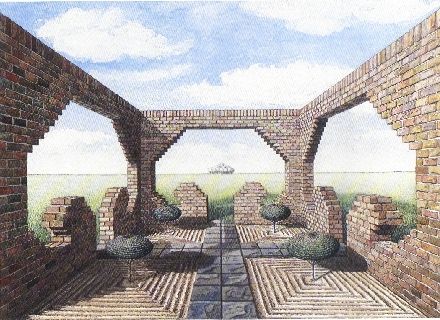
Yesterday, I received a pack with artworks by Jos de Mey. Above you can see the latest artwork by him. As usual, there's impossible figure on his artwork. He is my favorite artist in the field of impossible art.

Sunday, March 25, 2007

Anamorphic art

The word anamorphic is from the Greek "ana" (again) and "morphe" (form). It refers to images that are so heavily distorted that they are hard to recognize without the use of a mirror, sometimes referred to as an anamorphoscope. When viewed in the anamorphoscope, the image is "formed again", so that it becomes recognizable.

Anamorphic art as known from middle ages. European painters of the early Renaissance were fascinated by linear anamorphic images, in which stretched pictures are formed again when viewed on a slant. A famous example is Hans Holbein's "The Ambassadors" (1533), which contains a stretched-out skull.

Nowadays anamoprhic art is rised again because of works of such famous artists as István Orosz, Kelly M. Houle, Julian Beever and Felice Varini.

Hungarian artist István Orosz is well known for his artworks with impossible figures and constructions. He also tries to renew anamorphosis art. Frequently he uses etching tecnique for his artworks. Below you can see two views of his artwork "The Well" (1998). You can see the original image to the left, and a part of the same image with cylindrical mirror in the center of the well. We see face of M.C. Escher in the mirror.

Kelly M. Houle also creates anamorphic images for cylindic mirror. She working on projects including illustrating a children’s book manuscript, writing and illustrating a trilogy of fictional correspondence with an anamorphic theme. Below you can see anamorphic portrait of Leonardo da Vinci.


Julian Beever creates his artworks by chalk on roads and streets. His paintings can be viewed as real image from one point of view only.


Felice Varini paints (lines, concentric circles, triangles) on things (tunnels, castles, groovy interiors). A seemingly random smattering of elements that, viewed from a specific point in space, coalesce into a tangible planar element.

Monday, March 19, 2007

Visage of War

In 1940 Salvador Dalí created his painting Visage of War where eyes and mouth each contain a face, whose eyes and mouth each contain a face and so on. Painting this artwork Dalí thought about Spanish Civil War, and eyes are filled with infinite death. Perhaps Dali decided the infinite horrors of war were better depicted in a bounded canvas through self-similarity, though most certainly he had not been exposed to this as a mathematical concept.

Analogous fractal of order four can be viewed to the right.

Interestingly, a preliminary study (below) of this picture had a face within only one face within the mouth of the largest face.

Friday, March 9, 2007

Pythagoras tree

The Pythagoras tree is a plane fractal constructed from squares. It's named after Pythagoras because each triple touching squares encloses right triangle, traditionally used to depict Pythagorean theorem. If triangles of the tree have equal sides, the Pythagorean tree is symmetric, as you can see above, otherwise the tree is asymmetric. The illustration above shows eight iterations of tree construction progress.

Below it's shown asymmetric Pythagoras tree.

The shape of the tree can be used for creation of infinite impossible figure. Some parts of the fractal can be replaced to impossible triangles or squares. Illustrations below show symmetrical and asymmetrical impossible fractal tree.
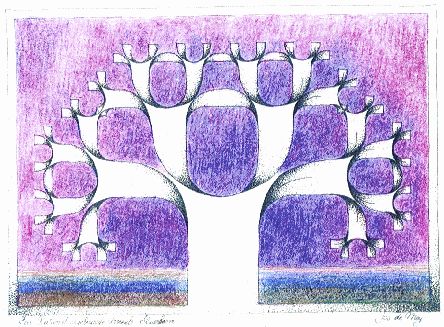
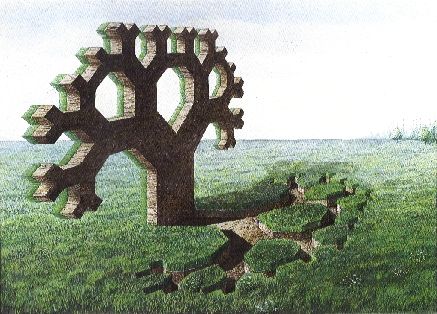
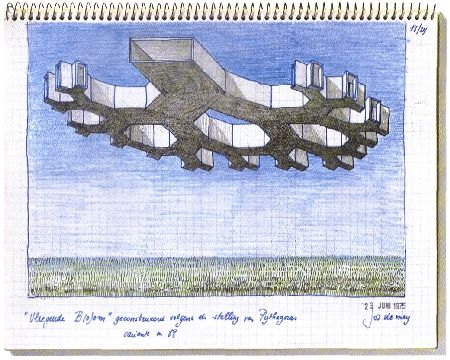
Flemish artist Jos de Mey created many artworks with Pythagoras tree as main motif. Below you can see his artworks.
Three dimensional effect can be applied to the Pythagoras tree. Illustrations below by Koos Verhoeff shows trees with applied various parameters.
Below you can bronse sculpture of Pythagoras tree which also created by Koos Verhoeff. the sculpture based on computer sketch above right. 
Upd 25.11.2008.
A very nice Pythagoras tree was created by hyperion_00001. Note, that younger leaf generations are located below older ones, which increase convexity of the figure.